The context-sensitive half time is a concept that relates the duration of drug(context) administration to the time required for a 50% decrease in plasma concentration.
It tells about how long it takes to recover after infusions of intravenous anaesthetics.
Thus, it is the time required for plasma concentration to decrease by 50% after discontinuation of a drug infusion ( Of varying duration, but maintaining a constant plasma concentration)
So, Why CSHT is based on time for a 50% decrease?
- to provide an analogy to half-life.
- very roughly, 50% reduction in plasma drug concentration appears necessary for recovery after administration of most I.V hypnotics at the end of surgery.
Recovery from Anaesthesia is determined by the drug’s pharmacokinetic and pharmacodynamic profile.
CSHT puts the following pharmacokinetic principles into play
1) Drugs get deposits in the body’s tissues until they are completely saturated. Once the drug infusion is stopped this stored drug will then redistribute back into the blood and maintain its effects.
2) Each drug accumulates to different extent.
3)Drug cleared from blood by 2 mechanism- excretion and distribution.
So, CSHT depends both on the clearance( elimination half- life) and drug distribution.
The longer the drug is given, the more drug accumulates in peripheral tissues, and the longer it takes to eliminate the drug at the conclusion of anesthesia and as a result CSHT increases.
Drugs with prolonged, variable CSHT eg., Fentanyl takes longer time to wear off whereas those with short, stable CSHT eg., Remifentanyl wears off quickly and predictably.
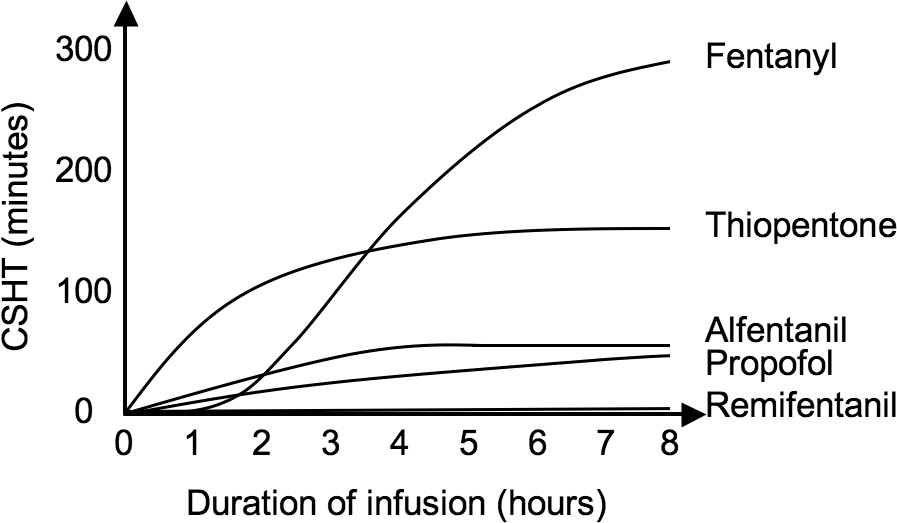
“The context-sensitive half-time of a drug describes the elimination half-time after a continuous infusion as a function of the duration of the infusion and is an important factor in the suitability of a drug for use as maintenance anesthetic. The context-sensitive half-time of propofol is brief, even after a prolonged infusion, and recovery remains relatively prompt”
Katzung, Bertram G. Basic & Clinical Pharmacology. New York: Lange Medical Books/McGraw Hill, 2004. Print.
 Hypnobot Lounge